
Issues & Advocacy
Hospitals in Rhode Island are the backbone of our health care system, open 24/7/365 and caring for anyone who walks through the door, regardless of their ability to pay.
Despite recent investments, Rhode Island's health care system remains in crisis. The financial stability of our hospitals is at risk, along with the ability to sustain access to care for Rhode Islanders.
To help address these challenges, HARI and its member hospitals support policies that will strengthen the health care system by eliminating red tape for patients and promoting long-term stability for hospitals. The legislative proposals below reflect those priorities.
Sponsored by Rep. Ackerman & Sen. Bissallion
The Issue
Hospitals in Rhode Island provide significant levels of uncompensated care each year, driven by coverage gaps, underinsurance and growing out-of-pocket costs. When patients lose coverage, the costs of care don't disappear -they are shifted onto hospitals.
In 2024, hospitals provided more than $84 million in uncompensated care.
Because of federal cutbacks, uncompensated hospital care is going to grow, resources will be stretched thinner and operational capacity will be eroded. If there is no mitigation for these losses, hospitals will be forced to make difficult decisions about services and sustainability.
What This Bill Does
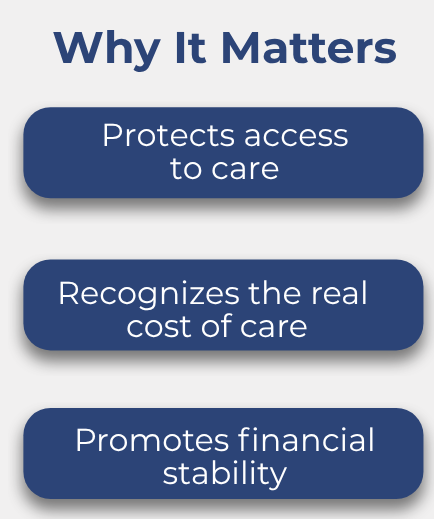
Ensures recognition of uncompensated care growth is added into the hospital rate cap.
Starting in 2027, the state's health insurance regulator must account for hospitals' unpaid care costs when setting limits on hospital payment increases.
Establishes clear guardrails and a transparent formula for the adjustment.
The state must calculate how much uncompensated care hospitals provide and update hospital payment limits each year to help cover those costs.
Helps protect patient access to hospital care.
Reimbursement that better reflects the cost of care and helps hospitals maintain staff, services, and timely care for patients.
Sponsored by Rep. Ackerman & Sen. Britto
The Issue
Rhode Island's health care providers, from hospitals to primary care doctors, negotiate contracts with health insurers that set the rules for coverage, reimbursement and many of the administrative requirements that affect how patients access care.
More recently, health insurers have begun making unilateral changes to contract policies, provider manuals and reimbursement rules. Providers often receive little notice and have limited ability to challenge these changes. When policies are modified midstream, services that were previously covered may suddenly be denied, limiting patient access to care and leaving health care providers without reimbursement.
What This Bill Does
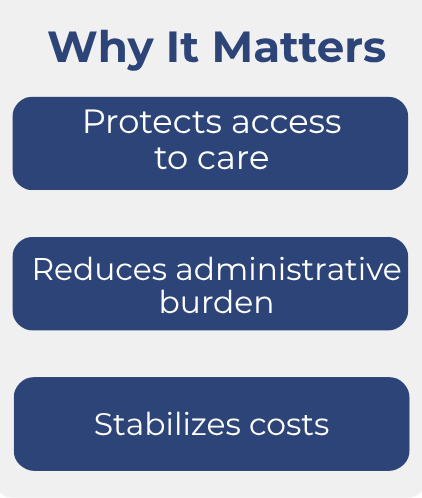
Prohibits unilateral mid-contract changes.
Health insurers and affiliated entities may not unilaterally modify, amend, or reinterpret any material contract term.
Protects material terms and patient services.
Clarifies that key elements of the provider agreement, including reimbursement, coverage rules, prior authorization, medical necessity, and billing requirements, are material and cannot be changed mid-contract.
Allows changes only in limited circumstances.
Modifications are permitted only:
• With mutual written agreement between payer and provider, or
• When expressly required by state or federal law.Requires advance notice at renewal.
Changes may take effect only at contract renewal and only with at least 90 days' written notice.
Sponsored by Rep. Donovan & Sen Thompson
The Issue
When patients leave a hospital, they often need post-acute care in settings such as nursing homes, behavioral health facilities, long-term care, rehabilitative services, or home care to recover safely.
Currently, many insurers require prior authorization before covering these services, which can delay care, leaving patients "stuck" in hospital beds. In addition to slowing access to needed services, these delays can pose negative consequences for patients, stress patients and families and add significant costs to the system.
Hospitals spend significant time navigating approvals instead of focusing on patient care, while patients face unnecessary barriers to the services they need.
What This Bill Does
Requires coverage for post-acute care services for a minimum of seven days without prior authorization.
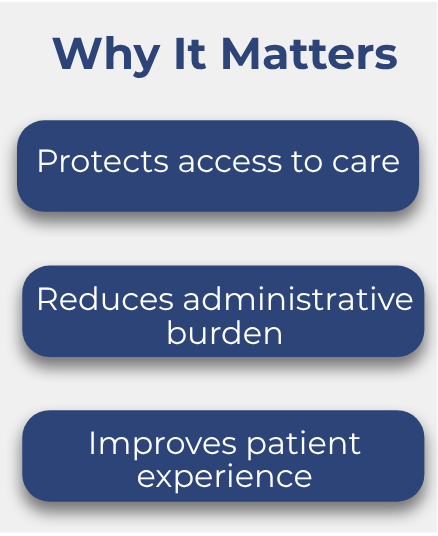
Eliminates prior authorization delays, reducing administrative burden while helping patients transition to post-acute care sooner.
Allows providers to determine medical necessity.
Keeps medical decisions in the hands of patients and their health care providers.
Sets a clear discharge process across Rhode Island.
A clear process cuts down on paperwork for providers and lowers the cost of care.
Improves patient experience and recovery.
Ensures patients can transition quickly to post-acute care, improving recovery and overall patient experience.
Sponsored by Rep. Noret & Sen Dimitr
The Issue
Many patients struggle to afford health care, especially those with chronic conditions or high-deductible health plans, as growing out-of-pocket costs for patients make care increasingly difficult to afford. When bills remain unpaid despite billing efforts, they are classified as bad debt-care already delivered for which providers receive no payment.
In Rhode Island, these unpaid amounts can reach tens of millions of dollars annually. As a result, resources are stretched thin, operational capacity can be strained, and hospitals are forced to make difficult decisions about staffing, services and patient care.
What This Bill Does
Reimburses providers for unpaid costs.
Insurers must pay at least 65% of unpaid co-pays, co-insurances, and deductibles $250 or more after reasonable collection efforts.
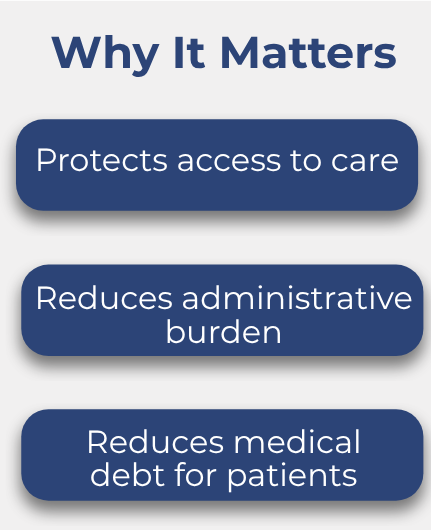
Reduces medical debt and protects access to care.
When insurers share responsibility for large unpaid balances, it protects patient access to care and helps hospitals continue serving their communities.
Sets clear documentation rules.
Providers must show they tried to collect unpaid amounts, like calls or letters, before submitting for reimbursement.
Aligns with guidance from the Centers for Medicare & Medicaid Services.
The process follows federal standards used by Medicare, so all health care providers are subject to the same rules.